Date
June 10, 2026
4 min read read
The Hidden Data Behind Tropicana's $30M Redesign Failure Nobody Has Ever Seen
By
Eko Widarto
Published
June 10, 2026
Category
Case Study
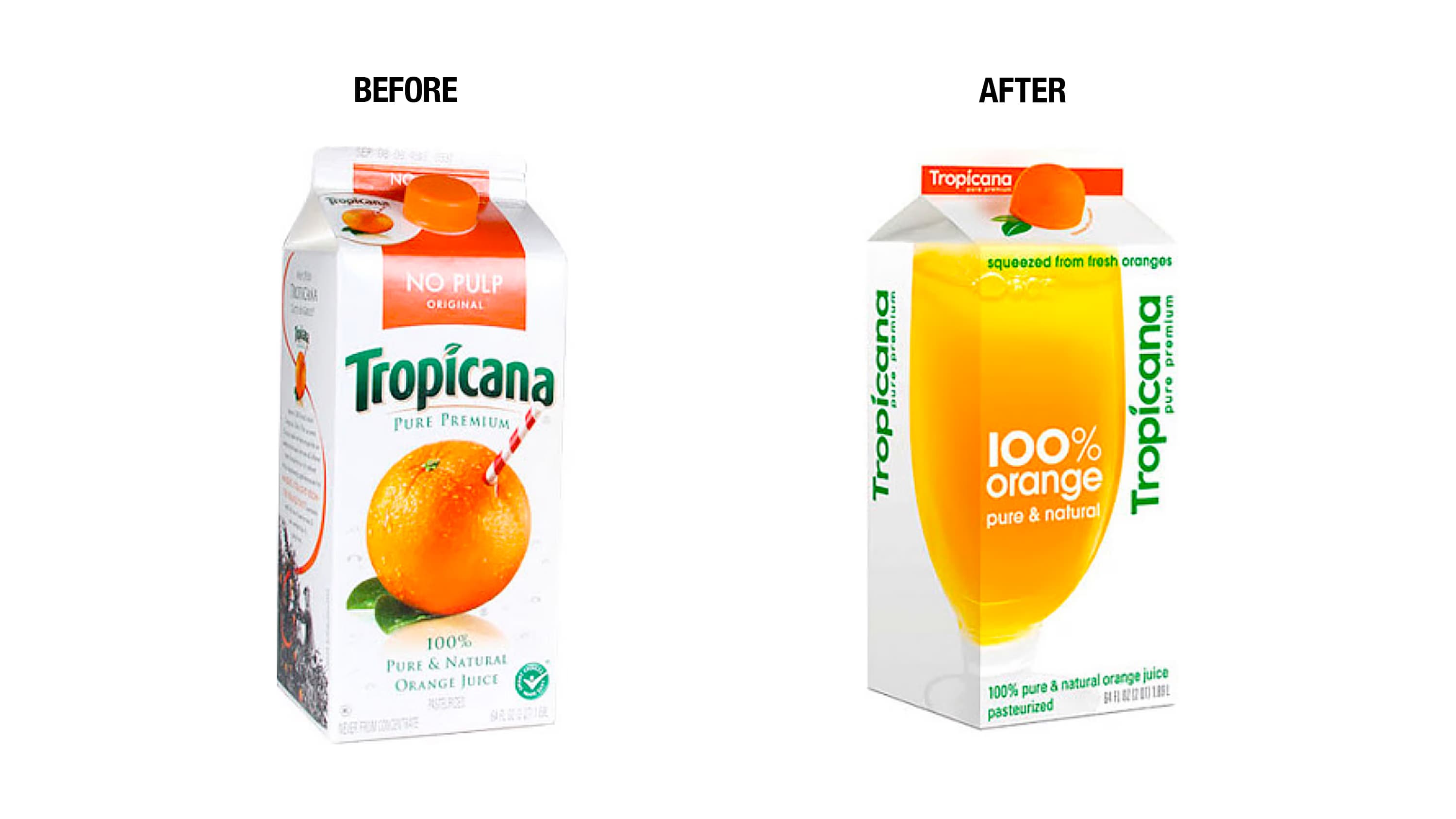
In early 2009, consumers began writing letters to PepsiCo. They were angry. Tropicana had disappeared from their local supermarkets.
The product was on the shelf the entire time.
That is the actual story of the Tropicana redesign: not a brand that lost $30 million, but a brand that became invisible to the people who had bought it for decades. The money is a consequence. The invisibility is the cause.
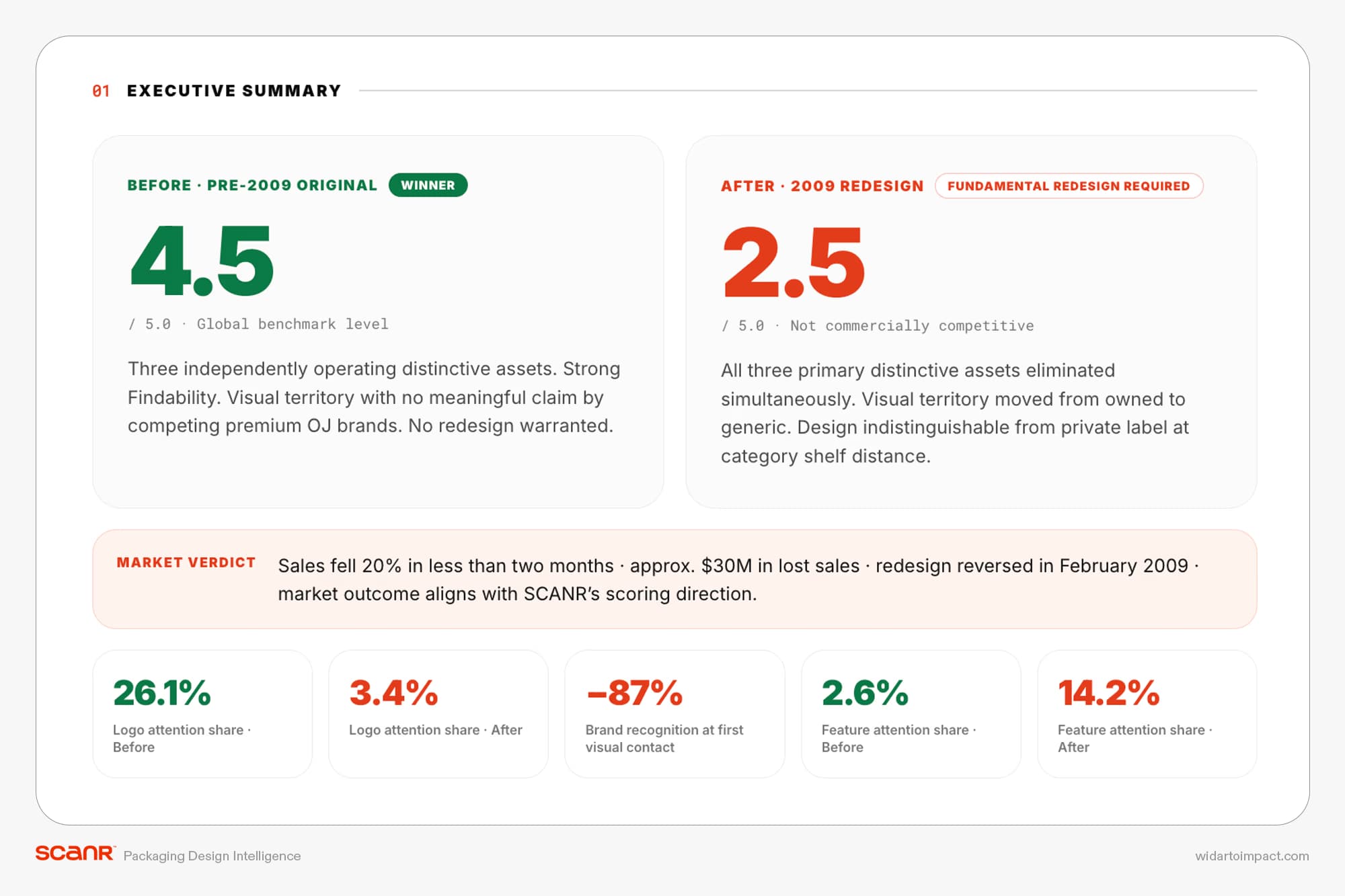
In January 2009, PepsiCo launched a redesigned carton for Tropicana Pure Premium, developed by the Arnell Group with a combined design and campaign investment of $35 million. The brief was legitimate: modernize the brand for a new generation of buyers. The execution was professionally competent. Within sixty days, sales fell twenty percent. Revenue losses reached $30 million. Including the cost of reverting, total damages were approximately $50 million. By March, Tropicana was back in its original design, as if January had never happened.
Three changes. Three consequences.
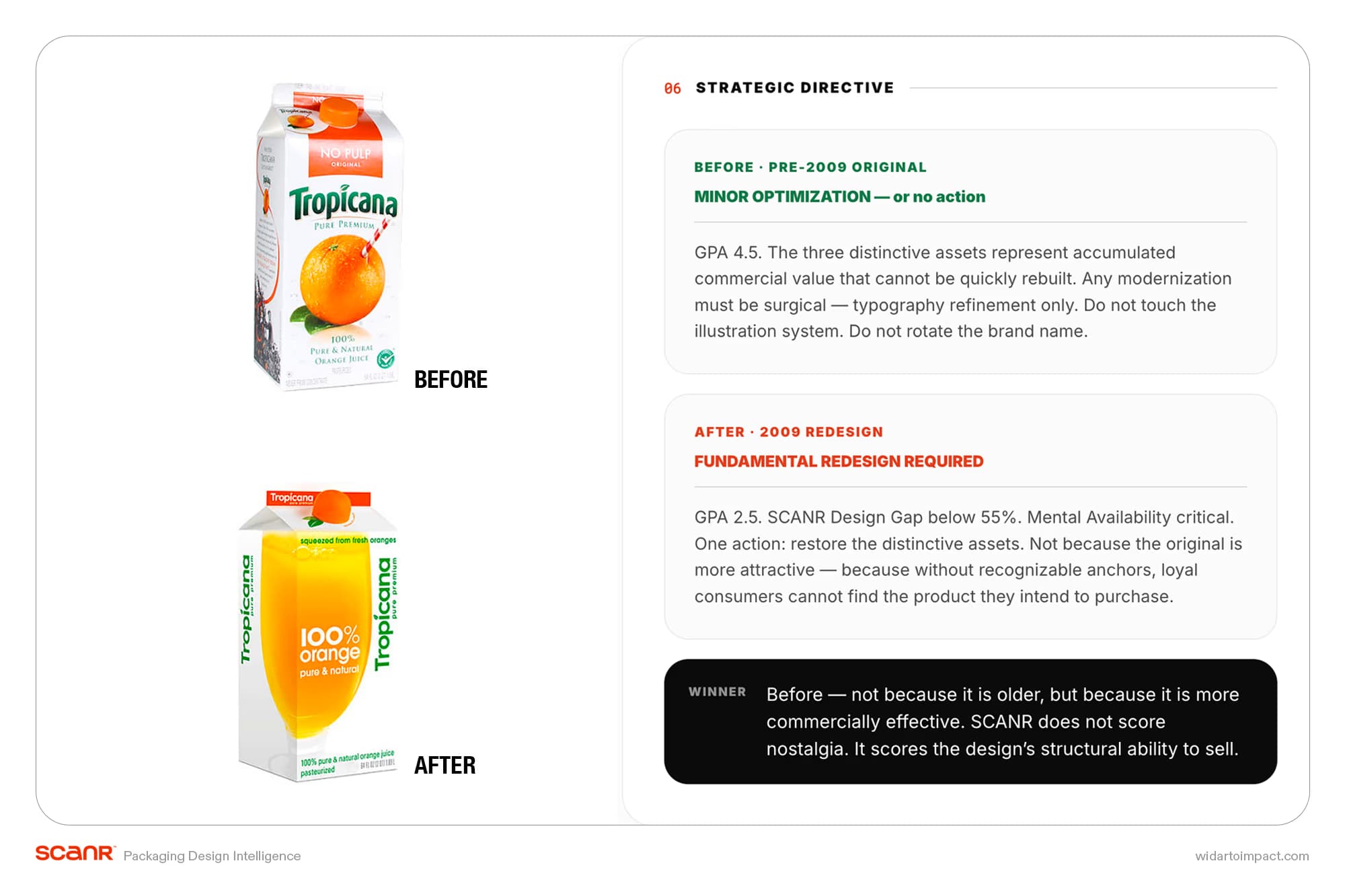
The Arnell redesign made three primary decisions: it replaced the iconic orange-and-straw illustration with a photograph of a glass of juice; it rotated the Tropicana wordmark from horizontal to vertical; and it changed the typeface.
Every analysis of this failure says the same thing: they changed too much. That assessment is directionally accurate and practically useless. It does not tell you which of the three decisions drove the loss. It does not assign weight to each one. It gives you nothing you could have used before a single carton went to print.
A structured pre-production analysis does.
What 44 means on a shelf.
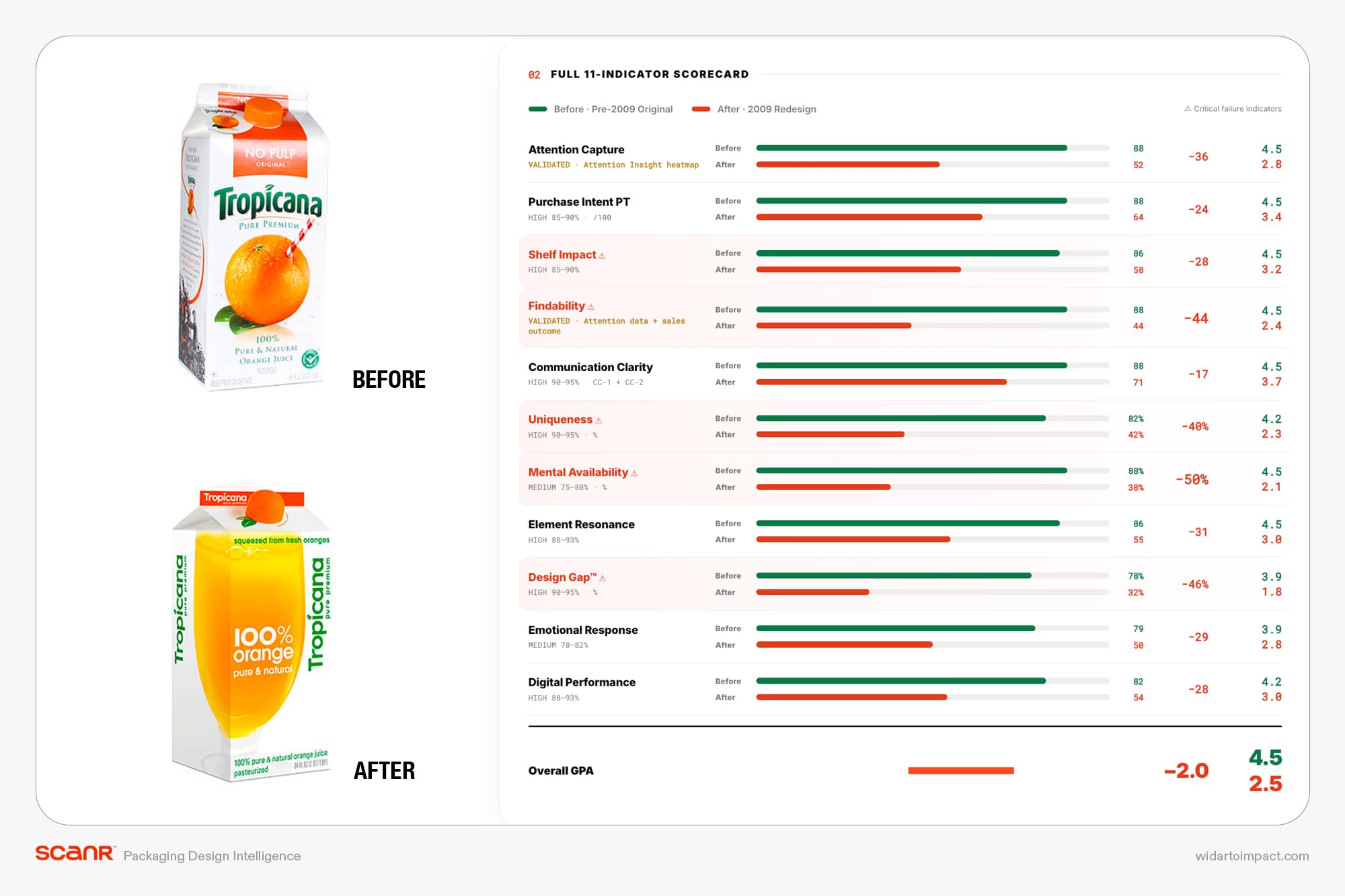
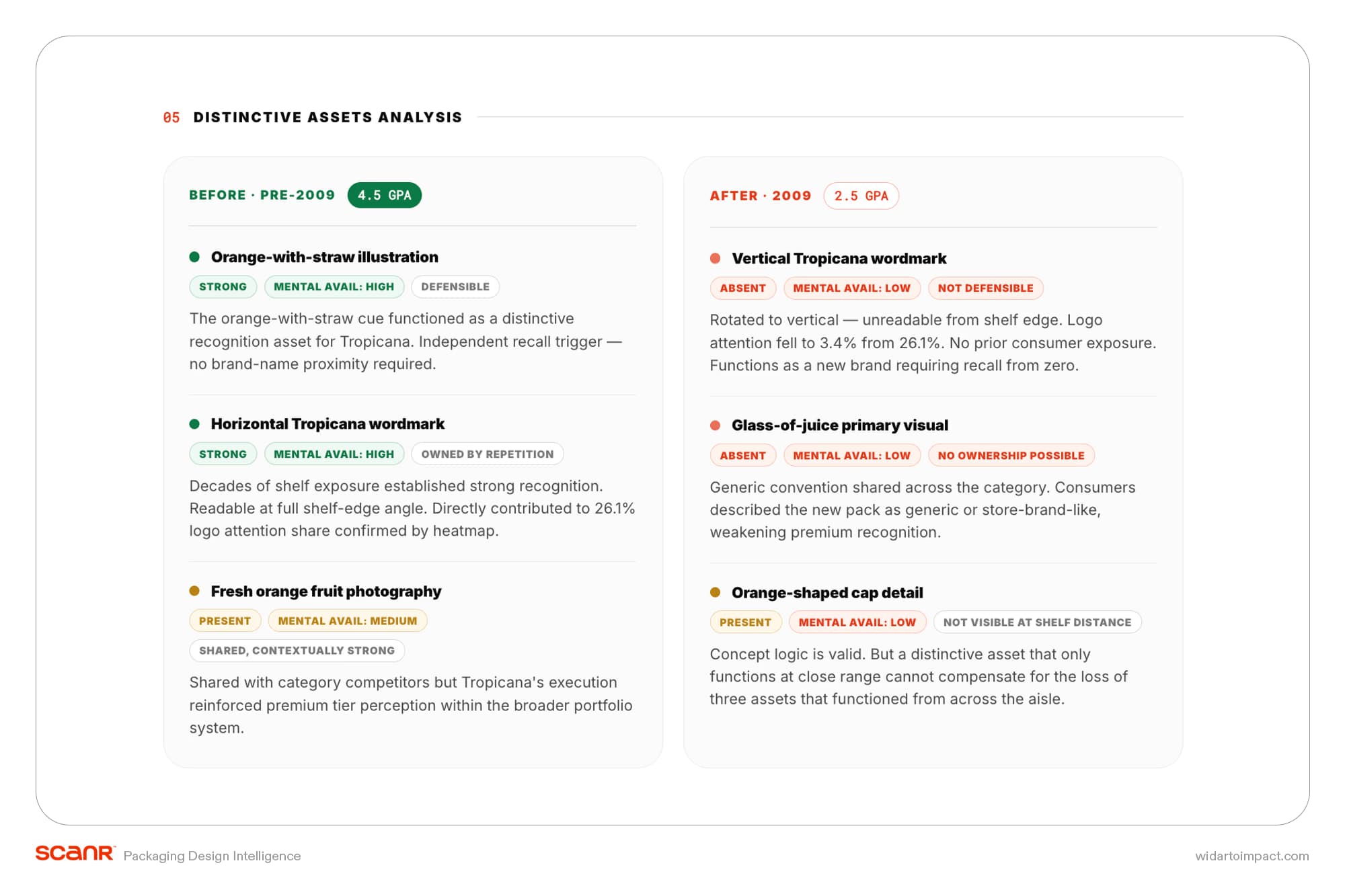
Findability measures how quickly a returning consumer can relocate a brand. At 88, the original Tropicana had three independent recall triggers: the orange with a straw, the horizontal wordmark, and the warm orange color. Any single one of them, appearing alone, was sufficient to identify the brand from across a retail aisle.
The redesign removed the orange with a straw. It degraded the wordmark through vertical rotation. The glass of juice that replaced the primary illustration is a category symbol: it tells you this is orange juice, the same information provided by every competing carton on the same shelf. It tells you nothing about which brand it is.
At 44, the scoring framework reads: consumer likely cannot reliably re-find brand. No distinctive assets. High confusion risk.
That is not a prediction. It is a description of what actually happened.
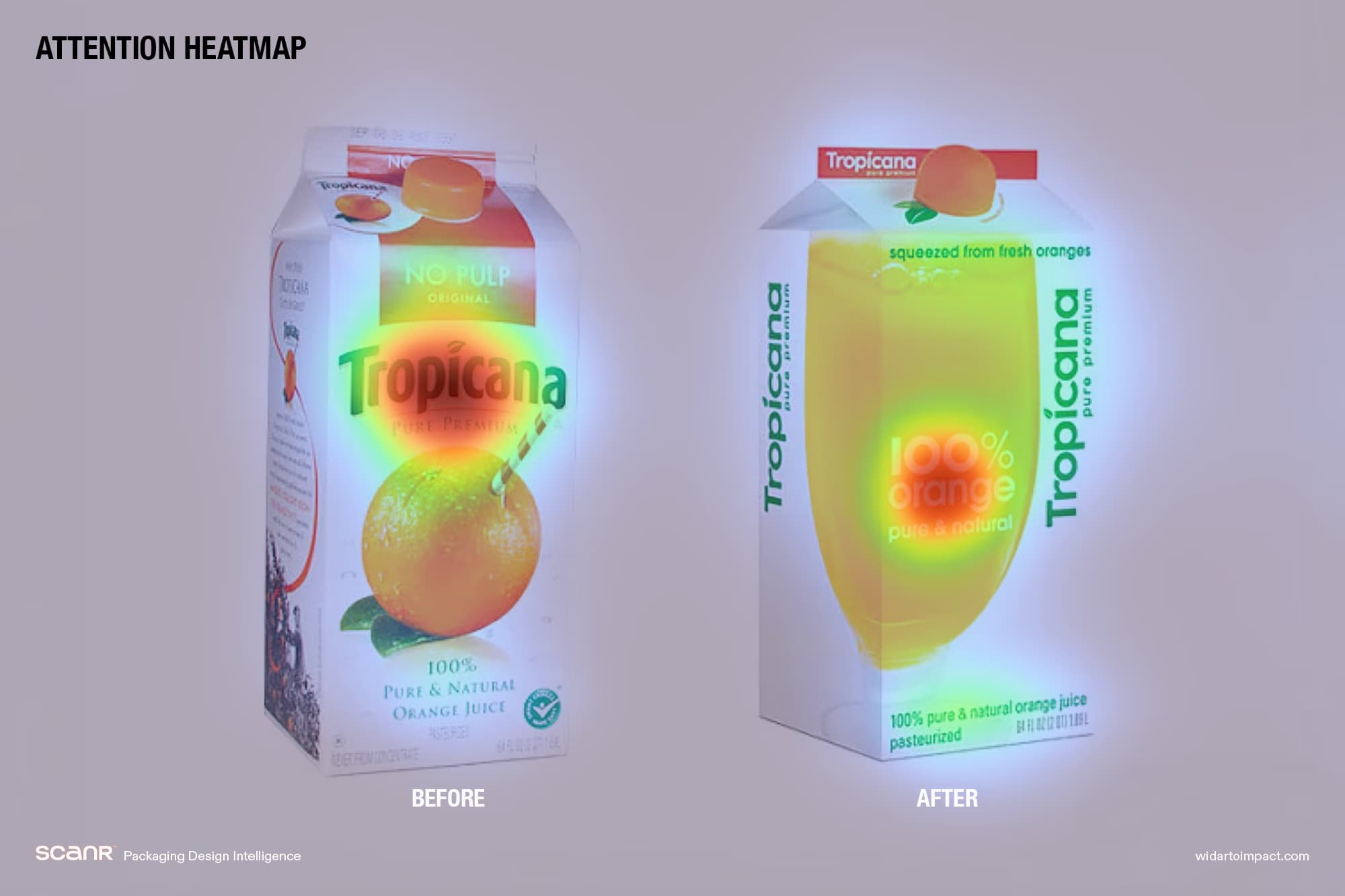
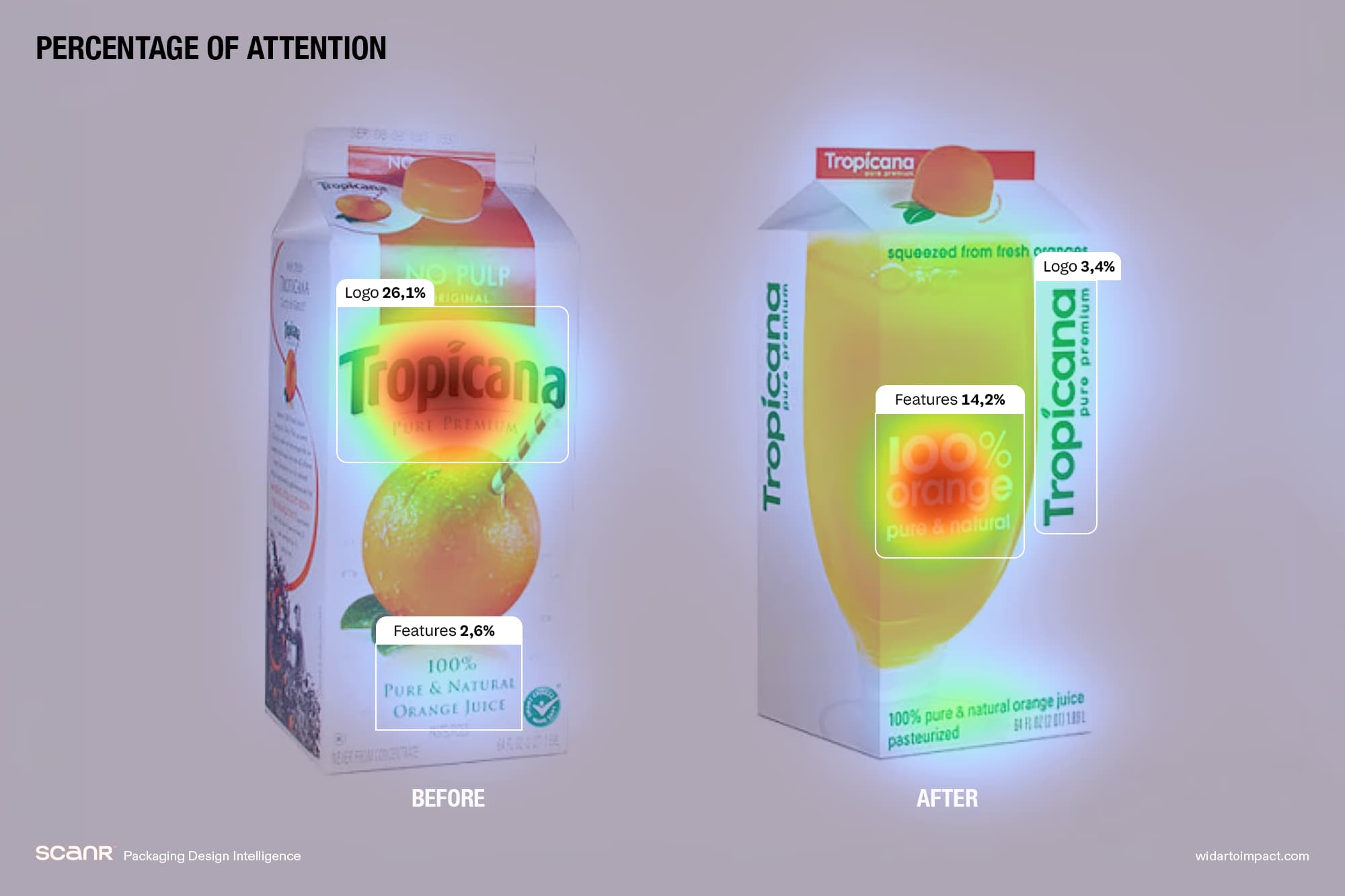
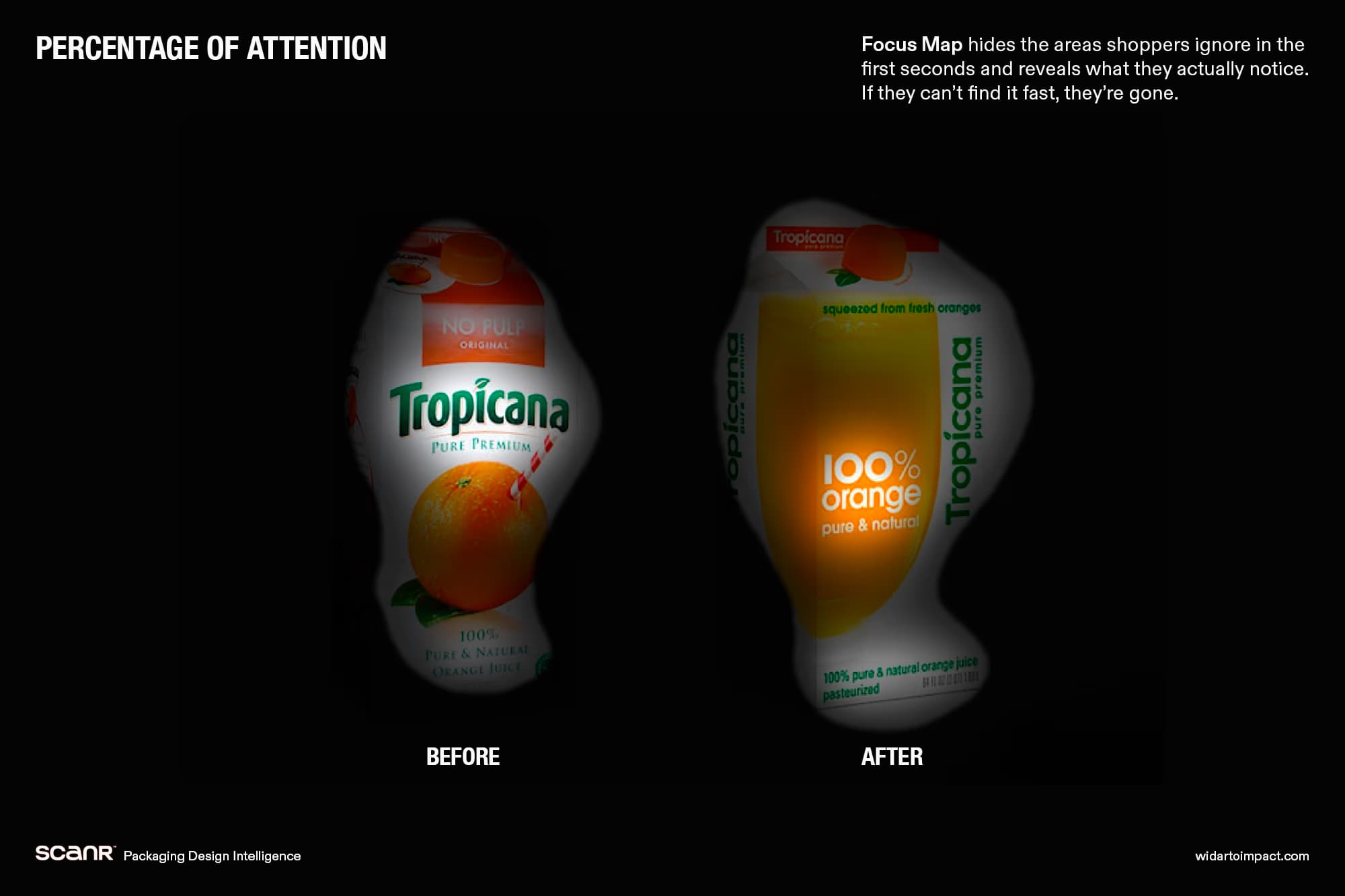
Mental Availability — the indicator measuring recall strength before the consumer is even standing at the shelf — dropped by fifty percent: from 88% to 38%. Logo attention share confirmed it: 26.1% before the redesign, 3.4% after. Brand recognition at first visual contact fell 87%.
Fifty years of built consumer memory. Erased in one design brief.
The one thing that partially held.
Communication Clarity recorded the smallest drop of any indicator: 88 to 71, a delta of 17 points.
That number tells a precise story. The 2009 redesign still communicated orange juice. The category was legible. A first-time consumer looking at the new carton would understand they were looking at a juice product within seconds.
What it could not communicate was which brand. The design succeeded at saying "orange juice" and failed entirely at saying "Tropicana."
This distinction matters commercially. Category communication and brand communication are not the same job. Tropicana lost the shelf not because consumers were confused about the product — but because the design had stripped every signal that made the brand locatable. The product was recognizable as orange juice. It was unrecognizable as Tropicana.
The problem was never the brief. It was the right execution of the wrong brief.
Why Incumbents are different.
Tropicana in 2009 was a textbook Incumbent brand: decades of retail presence, deep consumer recall, a visual identity consistently reinforced across every purchase occasion since the 1950s.
For an Incumbent, high Findability and Mental Availability scores are not projections. They are realized capital. The orange with a straw was not a heritage aesthetic choice; it was the mechanism through which fifty years of purchase behavior had been encoded in consumer memory.
Removing it did not fail to carry that equity forward. It actively severed it.
This is the distinction that most redesign analyses cannot see: the difference between potential and realized equity. A new brand that redesigns its packaging loses ground it had not yet built. Tropicana lost ground it had spent fifty years earning.
The directive.
A pre-production comparison of these two designs would have issued one verdict: original Tropicana. Do not proceed with redesign as currently executed.
The brief to modernize is valid. The execution requires revision, not approval. Retain the orange with a straw. It is not decorative: it is the recall mechanism the brand runs on. Update the color temperature. Refine the typography. Evolve every element that is aesthetic. Protect every element that is structural.
The cost of that analysis, delivered in twenty-four hours: $3,500 to $5,000.
The cost of proceeding without it: approximately $50 million.
SCANR™ is a packaging design intelligence service by Widarto Impact. SCANR analyzes packaging and brand visual systems against 11 structured commercial indicators to answer one question: will this packaging sell, before production begins.
This analysis applies the SCANR Compare methodology retroactively to publicly documented historical data. Attention data sourced from SCANR eye-tracking analysis. Sales figures sourced from academic and industry documentation of the 2009 Tropicana redesign. SCANR does not predict sales volume. It predicts design performance probability._